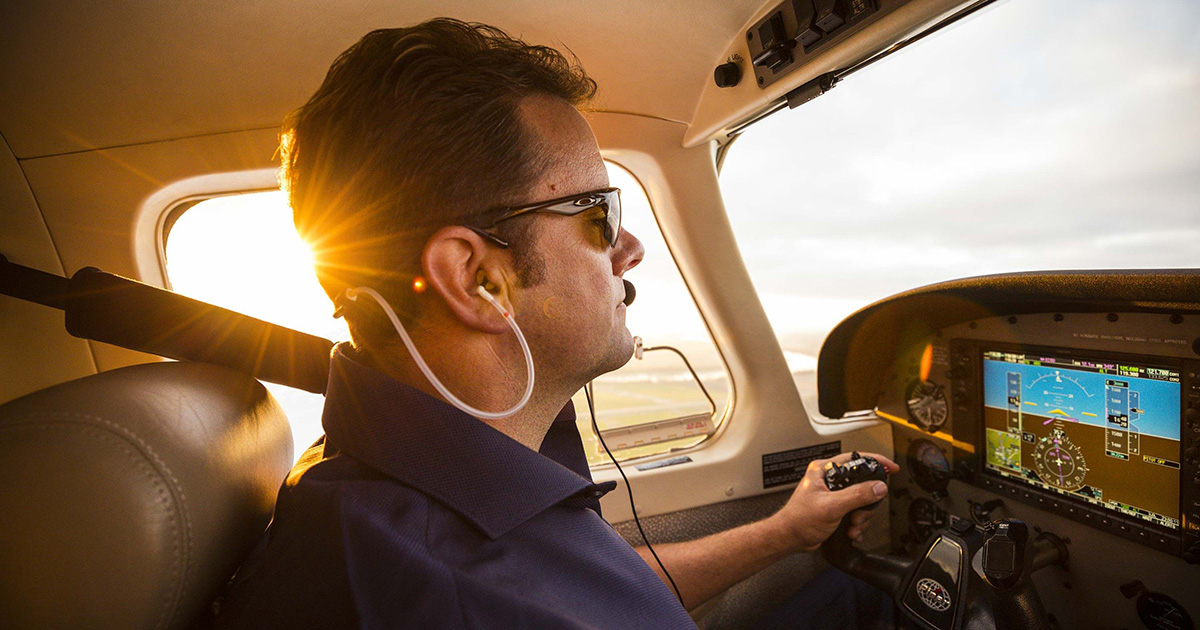
Modern cockpits engineered to reduce single-pilot workload can easily become a primary source of distraction or complacency if mismanaged. Speakers at the 2026 NBAA Single-Pilot Safety Standdown, held prior to the start of the NBAA Business Aviation Convention & Exhibition (NBAA-BACE), shared best practices for appropriate use of automation in the cockpit and overall risk management for single pilot operators.
Automation Use, Disuse, Misuse and Abuse
Alex Fiorini, a fractional jet operator, shared with attendees tips for appropriate automation use, keeping the flight deck balanced and pilot situational awareness sharp. Single-pilot operations inherently mean there is not a second pilot to monitor or challenge an automation problem, and no independent check of automation set up.
“Is the automation helping you solve the problem, or has the automation become the problem you are trying to solve?” Fiorini asked. “How much authority has been transferred from the human to the system, and how easily can the human intervene?”
Appropriate use of automation is an active task, not a passive one, he explained.
He also discussed the dangers of misuse, disuse and abuse in terms of trust or distrust in an automated system.
Misuse means a pilot trusts the system too much, typically resulting in monitoring the system less actively. Disuse is often the opposite – a pilot has too little trust in the system.
Fiorini described this as the “cry wolf” effect, where an automated system provides an alert unnecessarily, so the pilot eventually learns to disregard that alert. [LM1]
Fiorini encouraged pilots to be confident in their skills but not to assume a successful outcome means the process was correct. In other words, did a flight go well because the process was good or because the system had enough margin?[LM2]
“Automation is designed for expected conditions. The human is there, in part, for the unexpected combination of conditions,” Fiorini said. “The human is the adaptive element in the cockpit.”
Fiorini shared four best practices for automation use:
- Verbalize the mode or setting, even alone.
- Set personal “gates” – determining when an approach is not stable or configured in time.
- Practice reverting to simpler levels of automation and hand flying, when appropriate.
- Brief an “automations escape plan” before high-workload phases.
“Automation should reduce workload without reducing understanding,” Fiorini concluded.
Case Study: Risk Management in Single-Pilot Operation
Steve Thibault, owner of FlightProficiency and co-owner of SimFlite Minnesota, described a February 2026 single-pilot accident at Colorado’s Steamboat Springs Airport (SBS), examining the environmental, technological and human variables of the flight to help attendees build a personalized operational framework to catch escalating risks.
While it can be tempting to plug an airport into your GPS and go, focusing on preflight planning is one of the best ways to mitigate risk in single-pilot operations.
When flying to Steamboat Springs or any new-to-you airport, Thibault suggested attendees spend time prior to the flight learning as much as they can about the airport layout, surrounding terrain and aircraft performance requirements, as well as any relevant NOTAMs, airport remarks and weather.
Steamboat Springs, for example, has displaced runway thresholds, approach and landing lighting systems with limited visibility and other unique characteristics, which create risks but can be mitigated, if planned for in advance.
Thibault also encouraged attendees to review available approach procedures, identifying “yellow flags” and “red flags” such as atypical glide angles or circling minimums, and assess the best approach considering the conditions.
“Fly as many instrument approaches as you can,” Thibault said. “Fly an instrument approach, as often as you can, on every flight. You will learn so much from doing that. You’ll make mistakes but you’ll make mistakes in VFR conditions.”