
Continued strong demand for business aircraft, limited preowned inventory and rising prices across several market segments continue to favor sellers, although buyers are increasingly selective about aircraft condition, maintenance requirements and overall value.
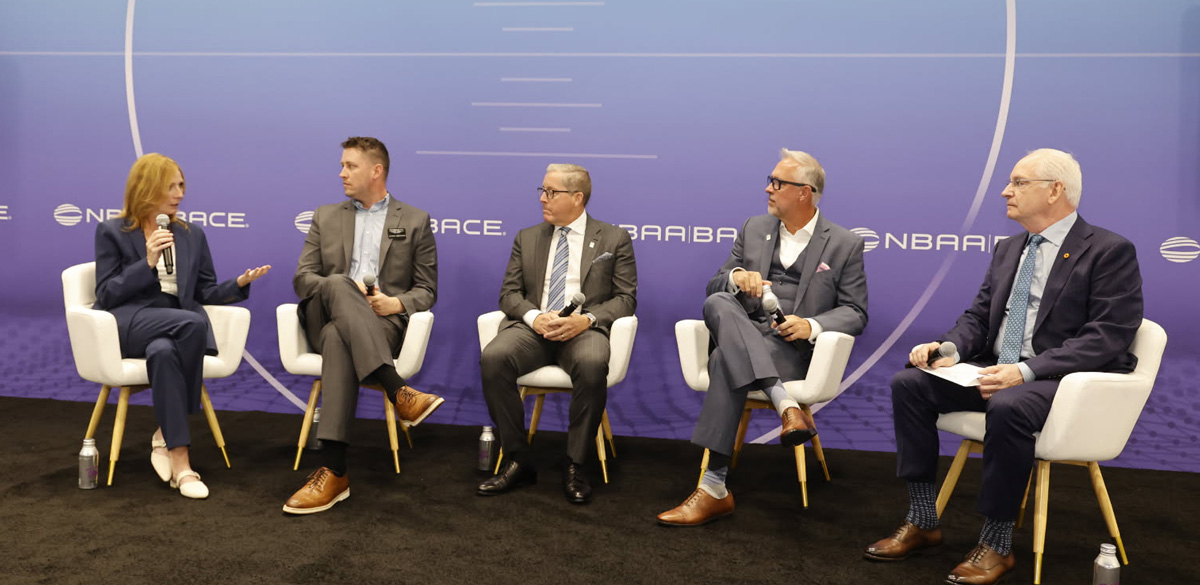
Those were among the takeaways from the "Market Outlook: Broker Insights" session at the 2026 NBAA Business Aviation Convention & Exhibition (NBAA-BACE), where aircraft brokers discussed current market conditions, changing buyer expectations and the growing importance of industry relationships in completing transactions.
“If you're interested in knowing what's going on in the market now, you really want to look at the preowned market,” said moderator Rolland Vincent of Rolland Vincent Associates. “There's around four transactions for every new airplane delivery out there.”
Demand for business aircraft remains exceptionally strong despite inflation, fuel prices and geopolitical uncertainty. "To say these are the ‘golden years’ is probably pretty accurate," said John Odegard, partner at 5x5 Trading and chair of the International Aircraft Dealers Association (IADA). "We're certainly living through a strong market, and it's been that way for a while."
Laurie Barringer, senior director of market research at ACASS, pointed to particularly strong demand for large cabin aircraft, where buyers must increasingly look beyond publicly advertised inventory. "What we're seeing more is the off-market section really picking up," she said. "We’re finding more of the aircraft we need before they actually hit the market.”
That’s the case with most other segments as well. With just 6.5% of the business aircraft fleet for sale, locating suitable aircraft has become more challenging than finding prospective buyers.
Chris Meisner, of Meisner Aircraft, estimated that approximately half of his firm's annual transactions occur on aircraft before they’re publicly advertised. "That’s really the value that a broker can bring, because we all have friends with airplanes that might be available but not yet officially on sale.”
Phil Winters, of Western Aircraft, attributed much of the sustained demand to customers progressing from charter to fractional ownership and ultimately whole-aircraft ownership. "Since 2020, the entire echelon has elevated themselves a step, which ultimately drives demand," he said.
Buyers Willing to Spend More
Despite generally favorable market conditions, aircraft condition and maintenance status remain critical factors in determining market value, with buyers willing to pay premiums for aircraft with attractive interiors, current maintenance and engine program coverage.
That also means aircraft waiting on parts, or with deferred maintenance or overdue inspections, may sit for months in the hangar. "There's not as much [buyer] willingness to take on a massive project just because they can get it for a little bit cheaper," Odegard said. "People are really favoring that turnkey, ready-to-go airplane."
"Somebody doesn't want to wait six to nine months to get something,” Barringer added, “so they're willing to pay a little bit more to get something they can take and go.”
Meisner described a Gulfstream G450 transaction in which the aircraft's market value increased approximately $2 million over the three months between contract signing and the final stages of the purchase. "You're seeing a lot of these transactions actually close because the buyer is seeing what's going on in the market," he said.
Winters cautioned, however, that recent appreciation should not fundamentally change buyers' expectations about aircraft ownership. "Let's not get punch drunk on airplanes being appreciating assets," he said, noting that aircraft historically lose value over time of ownership.
Several audience questions addressed the growing influence of AI in the broker space. All four panelists acknowledged AI as a useful starting tool for researching aircraft and analyzing market information, but not a substitute for a broker’s expertise.
"We use [AI] for data collection and analysis to try to provide our clients with better service," Odegard said. "But it’s hard to replace the human part of it at the end of the day."
The panel also addressed the influx of inexperienced brokers attracted by a strong market, emphasizing the value of professional accreditation, insurance, established relationships and proven transaction experience.
“We all have so much information at our fingertips,” Meisner concluded, gesturing across the busy NBAA-BACE exhibit floor, “[but] there will always be a need for a trusted governor for that information. That is the value of relationships.”