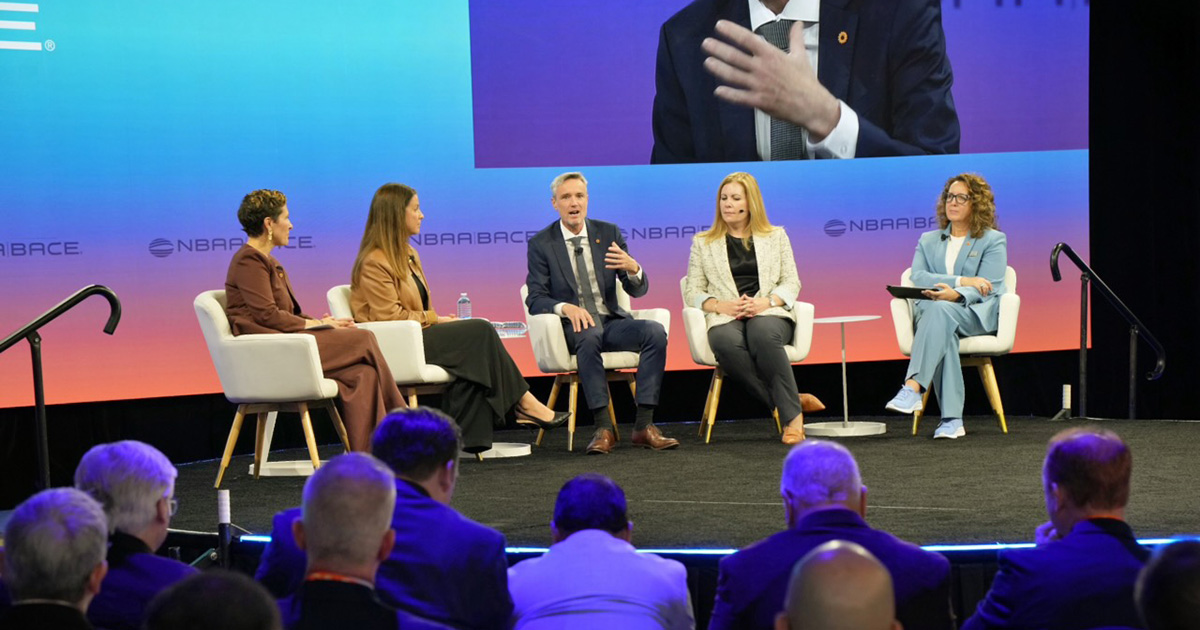
Senior officials from the FAA and the European Union Aviation Safety Agency (EASA) outlined efforts to modernize the air traffic control (ATC) system, streamline aircraft certification and other shared priorities during the popular Meet the Regulators session at the 2026 NBAA Business Aviation Convention & Exhibition (NBAA-BACE).
Moderated by NBAA Senior Vice President of Operations Heidi Williams and Kristie Greco Johnson, NBAA senior vice president of government affairs, the hourlong panel discussion included FAA Chief Technology Officer Rebecca Guy; Caitlin Locke, FAA associate administrator for the Aviation Safety Oversight and Certification Organization; and Ludovic Aron, EASA representative to the United States.
Guy emphasized that the FAA's ambitious ATC modernization initiative extends well beyond the nation's busiest commercial airports, with improvements planned throughout the national airspace system (NAS).
"We are going to be touching every single airport in the United States," Guy said. "We are putting in new connections and voice switches. That's going to all of our towers."
The initiative encompasses 16 systems, more than 12,000 individual projects, approximately 10 million labor hours and 52 vendors. "The technology is there,” she added. “The ability to deploy this is already there for us to go forward. It's the coordination."
Guy credited aviation stakeholders, including NBAA and other members of the Modern Skies Coalition, for helping secure congressional support for the project. "Having our stakeholders fighting for this really makes the $12.5 billion amazing, and we hope to get the $30 billion to keep going," she said.
Locke outlined her vision for the FAA's recently reorganized Aviation Safety Oversight and Certification Organization, emphasizing more timely regulatory decisions and greater clarity for applicants.
"How can we go faster to bring more safety into the system, and how can we be more predictable in what our expectations are going to be, and how we're sharing them transparently with the industry that we regulate?" she said.
Locke also highlighted efforts to modernize pilot medical certification, supplemental oxygen requirements and emergency medical kits, moving toward a more performance-based approach, avoiding reliance on outdated lists of medications and equipment that may no longer be readily available.
The FAA also is pursuing more streamlined medical certification pathways for pilots with certain medical conditions, including non-insulin-dependent diabetes, while reducing application backlogs.
Strengthening International Regulatory Harmonization
Aron and Locke emphasized growing cooperation between the FAA and EASA on aircraft certification, maintenance, pilot licensing, simulator requirements and safety data sharing.
Locke noted officials from both agencies communicate regularly to resolve regulatory differences and establish common approaches. "Nobody designs an airplane to only operate it in the U.S.," she added. "There's obviously going to be an international component."
Aron highlighted a recently expanded commitment to safety data sharing and coordinated rulemaking, including efforts to leverage information from voluntary aviation safety reporting programs. He pointed to growing concerns over global navigation satellite system (GNSS) interference as an example of where international cooperation could improve safety.
"The benefit of sharing notes, sharing what are the procedures that pilots and operators can apply consistently around the world to mitigate the risk, how to make aircraft more resilient to GNSS interference, is something that we need to work together," Aron said.
While operational data sharing between the agencies is already progressing, harmonizing regulations remains more challenging. Aron expressed hope the agencies could identify a significant joint rulemaking initiative within approximately six months.

Preparing for Emerging Aviation Technologies
Panelists also examined efforts to integrate eVTOL aircraft, unmanned aircraft systems and other advanced aviation technologies into the NAS.
Locke highlighted the FAA's Electric Vertical Takeoff and Landing Integration Pilot Program (eIPP), which allows regulators to gain real-world operational experience while developing appropriate certification and operating requirements.
"The eIPP really gives us an opportunity to better understand what the capabilities of these new entrants are going to be," Locke said. "Not just eVTOLs, but there's other applicants that can participate in the process as well."
Similar regulatory approaches are under consideration in Europe, Aron noted, potentially incorporating limited-scale operational trials or "regulatory sandboxes" to collect data and refine requirements.
Guy added that modernized ATC infrastructure will provide a foundation for integrating new entrants by improving reliable communications, surveillance and data sharing throughout the NAS.
Following the session, the representatives were joined by Transportation Security Administration (TSA) officials Kathia Pinard and Jimmy Elmore in hosting individual breakout sessions, allowing attendees to discuss their specific questions and concerns, one-on-one.