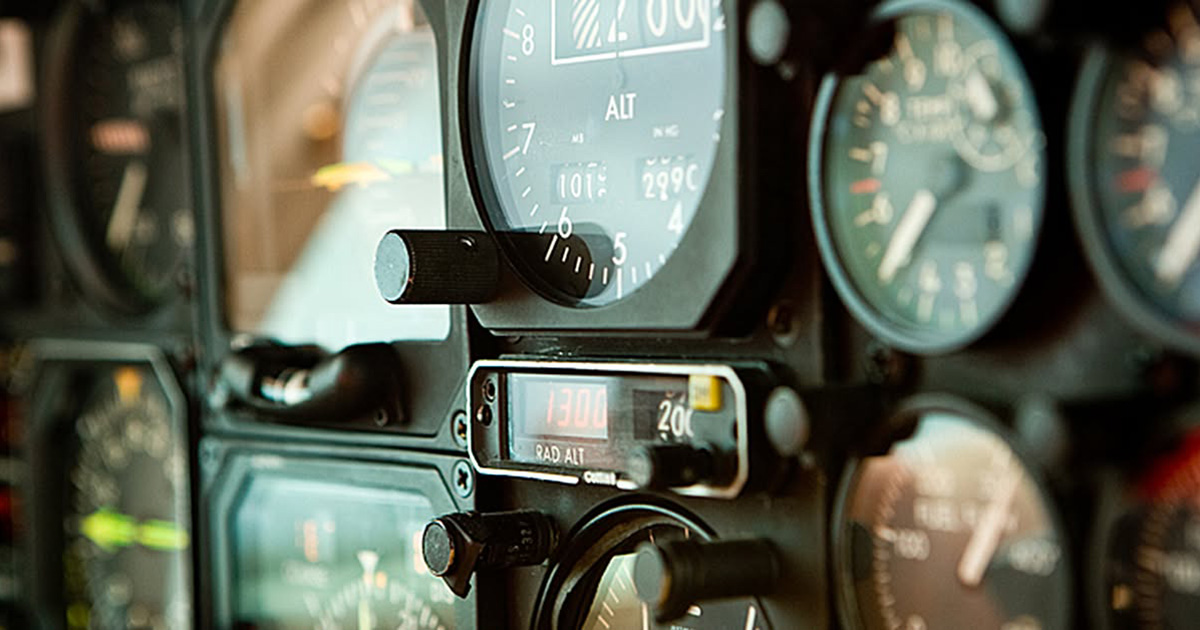
Certain business aircraft operated under Parts 91 and 135 must replace radio altimeters by Oct. 31, 2034, or be grounded. That new mandate impacts tens of thousands of aircraft, but fortunately the aviation industry successfully advocated for an incentive program to offset costs related to radar altimeter replacements.
On Oct. 20, experts at the 2026 NBAA Business Aviation Convention & Exhibition (NBAA-BACE) described the mandate, deadlines and funding options.
A radio altimeter provides real-time, height-above-terrain altitude data that supports critical flight crew decisions and operations, while also feeding key data to numerous safety-critical aircraft systems.
Earlier this year, the FCC proposed allowing expanded wireless telecommunications use in the Upper C-band spectrum (3.98–4.2 GHz), which overlaps with frequencies used by radio altimeters to transmit safety-critical data. The agency plans to auction portions of this spectrum, potentially generating billions of dollars.
“Federal Communications Commission [FCC] and FAA parallel actions are culminating in a deadline to replace radio altimeters for Part 121 aircraft by Oct. 31, 2030, and for Part 91 and 135 aircraft by Oct. 31, 2034,” said NBAA Senior Vice President, Operations Heidi Williams.
“This is a new framework. The auction sells off more than 100 MHz that are closer to the radio altimeter bandwidths we have now,” said Jens Hennig, vice president operations at the General Aviation Manufacturers Association (GAMA), explaining the specifications of your current radio altimeter will dictate whether your equipment needs a filter, another update or a full replacement.
Panelists encouraged attendees to be on the front end and begin seeking solutions sooner rather than later.
“To avoid bottlenecks, the early bird gets the worm. This will affect every radio altimeter in every aircraft n every type of operation” Eddie Straub, staff design engineer Garmin International. “Talk with your OEMs and your radio altimeter supplier now to know if the changes are effectively minor changes at the TSO level. Then you have no additional show of compliance necessary. If you don’t have an upgrade path that is a minor TSO change, you have more work ahead.”
Garmin International, one radio altimeter supplier, is ramping up production to meet the compliance deadline. Straub anticipates more delays from installation facilities than from equipment suppliers.
“You need to start planning now,” said Hector Huezo, chief operating officer of the National Air Transportation Association (NATA).
Aircraft owners and operators will not carry the entire cost of upgrades or replacement, thanks to industry advocacy for an incentive program paid for through the FCC auction proceeds.
“The industry actively engaged and got some money on the table. It might not cover your entire upgrade, but it is a rebate to cover some costs,” said Hennig. “What’s the artifact you have to present to participate in the rebate program? That’s a question the FCC is working to determine now.”
Straub explained the $3.5 billion incentive program is a maximum amount. When the rebate is exhausted, the program closes.
“It is not a full reimbursement program. It’s a rebate program and there’s also a cap for Part 91 and 135 operators,” Hector added. “For the 91 and 135 operators, whatever data is needed for that rebate needs to be quick, fast and efficient for the operators to get the rebate back.”
Aircraft operated by foreign operators under Part 129 in the U.S. are required to comply with the equipment mandate, too, but are not eligible for the rebate program. The International Air Transport Association (IATA) has sued the FCC on this matter.
For U.S. operators, the experts’ guidance is clear – begin researching your compliance options now.
“If you are a Part 91 or 135 operator required to upgrade, start the process now,” said Huezo.