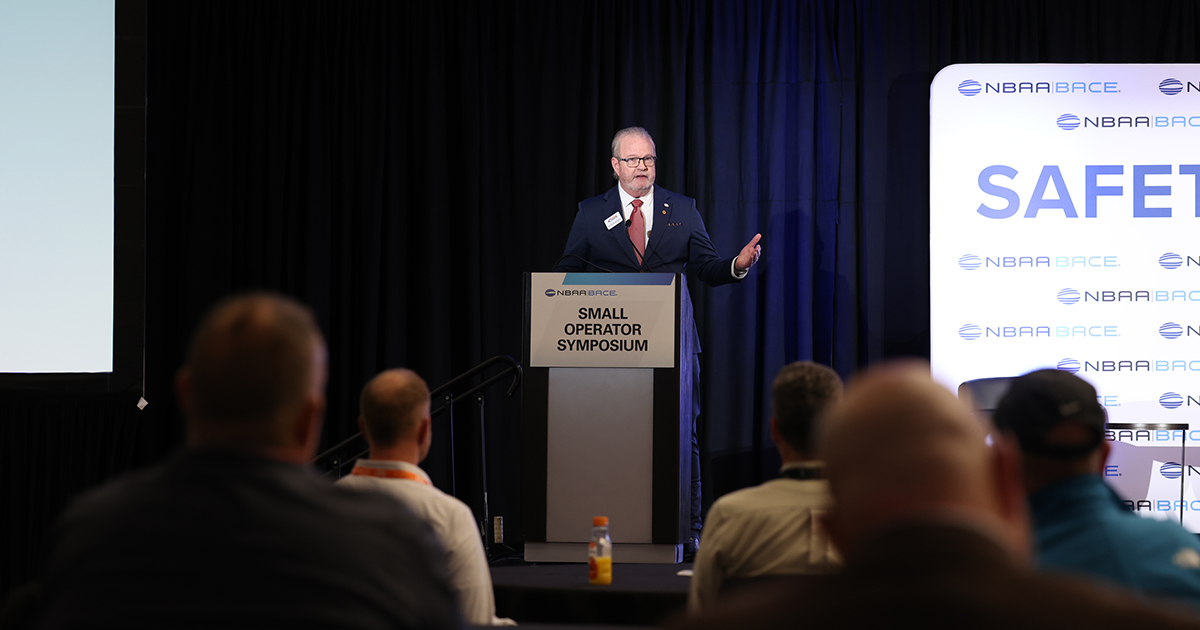
Strong leadership, a positive organizational safety culture and sound aeronautical decision-making are essential to safe, effective business aviation operations, particularly in smaller flight departments with limited personnel and resources.
Held Oct. 19 ahead of the 2026 NBAA Business Aviation Convention & Exhibition (NBAA-BACE) in Las Vegas, the 2026 NBAA Small Operator Symposium explored how developing and retaining experienced employees, establishing sound operating practices and empowering pilots to make difficult decisions can help flight departments operate more safely and effectively.
The Challenges of the ‘Accidental Director’
Dr. Christopher Broyhill, CAM Fellow, of Air Comp Calculator, LLC, opened the symposium by examining the increasing prevalence of aviation professionals who assume leadership responsibilities through circumstance rather than planning.
“An ‘accidental director’ winds up in a position that nobody has necessarily trained you for,” he said. “You are there as a function of tenure, or because you're the next body available. You're basically placed in a position of responsibility for which you've probably not had the training, mentoring development.”
Those leadership shortcomings can undermine organizational culture, employee retention and safety, particularly in smaller operations where individual employees have an outsized influence.
“Leadership drives the organizational culture, which drives the safety culture,” Broyhill said. “That generates compensation and quality of life changes, which drives retention, and then the cycle repeats itself, either for better or for worse, for good or for bad.”
Offering competitive compensation is essential to halting that cycle, enabling smaller flight operations to retain experienced personnel and the institutional knowledge they bring to an organization. “Pay is your culture talking,” Broyhill said. “Bad pay does not exist by itself.”
Overcoming ‘Get-There-Itis’
The symposium’s final session examined the human factors behind go/no-go decisions, emphasizing the importance of recognizing when changing conditions warrant delaying or canceling a flight.
“Are you spring-loaded to go or are you spring-loaded to stop?” asked Scott Birdsall, co-chair of the NBAA Small Flight Department Subcommittee and chief pilot for Lionheart Holdings.
Flight crews often feel compelled to continue a mission because of time, money and effort already invested in completing it. “These sunk cost fallacies are the ultimate in get-there-itis,” he added. “The NTSB will often refer to this as plan continuation bias.”
Birdsall examined two scenarios in which crews faced the decision of whether to go or stop. In one case, the crew opted to depart in strong crosswinds so that neither they nor their passengers would be inconvenienced by delays, a choice that led to a runway excursion on takeoff.
In the second example, the crew also faced challenging weather conditions including reduced visibility and snowfall. Even after $14,000 spent on two rounds of deicing treatments, the crew recognized the continued, deteriorating conditions and opted to return to the ramp to wait for the storm to pass.
“The decision to go or not go should be based not on past planning, past events or past money spent,” he said. “It must be based on the weather and the conditions that are in front of you … [And] you must have the psychological ability to separate the goal of the flight from the necessity of it.”
Rethinking Rejected Takeoffs
Robbie Moon, a Gulfstream pilot for Deere and Company, extended that disciplined mindset to rejected takeoffs – a timely topic after a Dassault Falcon 50 overran the runway while departing Sunday from Las Vegas’s Harry Reid International Airport (LAS).
While the possible causes of that non-injury accident are not yet known, Moon noted pilots often have only seconds to evaluate an unexpected indication and decide whether to stop or continue. “What the accident data bears out on takeoff is that, in general, we are attempting to stop when it would be safer to continue, and this is what is causing some fatalities,” he added.
Moon advocated simplified, aircraft-appropriate takeoff briefing criteria to make the decision. “The real low-hanging fruit in business aviation is to not troubleshoot while you're going down the runway,” he added. “It's to simplify your procedures and brief to match the real-world data to prevent future accidents.”
Both Moon and Birdsall encouraged scenario-based training and greater communication between captains and first officers, particularly when less-experienced pilots question a decision or call to abort.
“I want to hear more stories that I didn't see on Facebook in the morning,” Birdsall added. “I want us to share those stories more, and I want to encourage you to know that it's okay to not go.”