
From low-cost conspicuity solutions enabling drones to safely operate beyond visual line of sight (BVLOS) in low-altitude airspace with crewed aircraft, to AI-supporting flight department decisions, a session at the 2026 NBAA Business Aviation Convention & Exhibition (NBAA-BACE) examined how emerging technologies present new opportunities for business aviation.
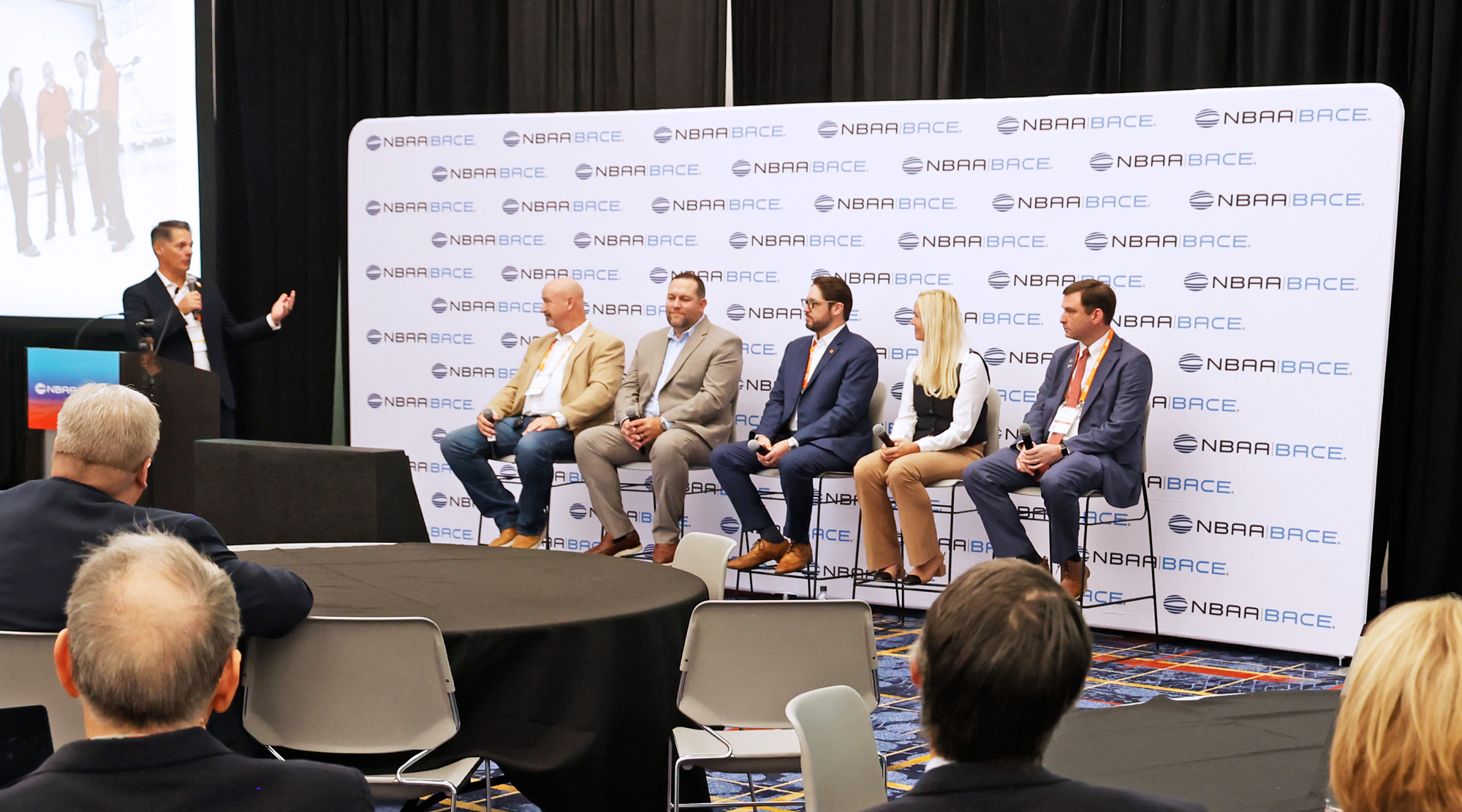
Moderated by Jon Damush, chair of NBAA's Emerging Technologies Committee, the panel featured companies already operating drones under waivers and exemptions granted under Part 107. A proposed Part 108 follow-on rule would replace those special use cases with certificated standards, streamlining the approval process.
"What we're really looking forward to under Part 108 is we're not going to have that scaling problem anymore," said Rachel Carlstrom of the FAA's Emerging Technologies Division. “The rule includes lessons learned from all the work that’s gone into every expansion [under Part 107].”
Cargill, which operates approximately 100 drones globally, expects to pursue Part 108 certification to accommodate continued expansion of its fleet. “Shifting to the compliance-based approach is going to be a lot easier for us than multiple waivers with different use cases in different areas," said Calvin Reed, global drone program leader for the company.
A separate Part 146 rule would enable operators to incorporate FAA-reviewed third-party services such as UAS traffic management (UTM), detect-and-avoid capabilities and weather information, rather than developing those systems independently.
Dallas Brooks, head of standards and aviation at Wing Aviation, described how the company uses UTM to coordinate thousands of drone flights, with operations currently spanning five U.S. metropolitan areas and plans to expand to 17 by the end of 2027.
"UTM is essentially what the [FAA’s] NextGen aviation system was supposed to do," Brooks said,” and that's deconflict aircraft on direct point-to-point routes in time and space using 4D reserve trajectories.”
Such capabilities could eventually benefit the broader National Aviation System by improving traffic flow and enabling more efficient routing for both crewed and uncrewed business aircraft. However, integrating drones remains a significant challenge, particularly in metropolitan areas and regions with limited electronic surveillance coverage.
"There's a lot of unscheduled traffic that will make this a very difficult thing to do without heavy reliance on dynamic deconfliction," said David Smith, CEO of Robinson Helicopter Company, which recently established an uncrewed aircraft division.
Lower-cost electronic conspicuity technologies offer a promising solution, with the added benefit of reduced weight. “As long as the refresh rate is high, position and altitude are all I need,” Brooks said. “I can extrapolate your speed and if you’re climbing or descending. I don't need to know who you are.”
The Role of AI
The discussion also addressed AI's potential to improve efficiency and decision-making, but panelists emphasized the distinction between advanced automation and systems capable of independently learning and modifying their behavior.
"Aviation safety is based on predictability," Brooks said. "The approach Wing has taken is to use extremely high and sophisticated levels of automation [so] that the behavior of the aircraft is always, always, always predictable."
SayFlight Founder Toby Benenson offered a practical example involving an aircraft-on-ground situation in which an AI assistant identifies a replacement aircraft and drafts a customer notification before maintenance availability or crew assignments have been confirmed.
"Before automation moves from recommending to acting, I see there are five things that need to exist: authority, scope, meaningful oversight, failure management and documentation,” he said. “None of those are really about technology.”
Carlstrom also discussed the FAA's eVTOL Integration Pilot Program (eIPP), which is gathering operational data to inform future regulatory decisions.
Even at less than 90 days in, initial flights have already helped the agency evaluate aircraft battery performance, environmental effects, interagency coordination and the integration of new aircraft types into existing airport environments.
"We're learning a lot,” she said. “I think it will inform whether [BVLOS] operations are different enough that we need to do something different, or if we can incorporate these aircraft into what we have now.”
Throughout the discussion, panelists stressed that successful integration of emerging technologies will depend on industry collaboration, reliable data sharing, cybersecurity protections and regulatory frameworks that accommodate innovation without compromising safety.
"As in all forms of aviation, participation equals safety," Brooks said. "The more people who participate, the safer you can be."